Magnolia grandiflora ‘Bracken’s Brown Beauty’
Donated courtesy of Bernie and Pamela Harris
planted by Mike Tummins of the Dickson Beautification & Tree Management Board November 15, 2024
Common Name(s): Bull Bay, Large Tree Magnolia, Southern Magnolia
Previously known as: Magnolia angustifolia, Magnolia elliptica, Magnolia foetida
Phonetic Spelling
mag-NO-lee-ah gran-dih-FLOR-ah
Description:
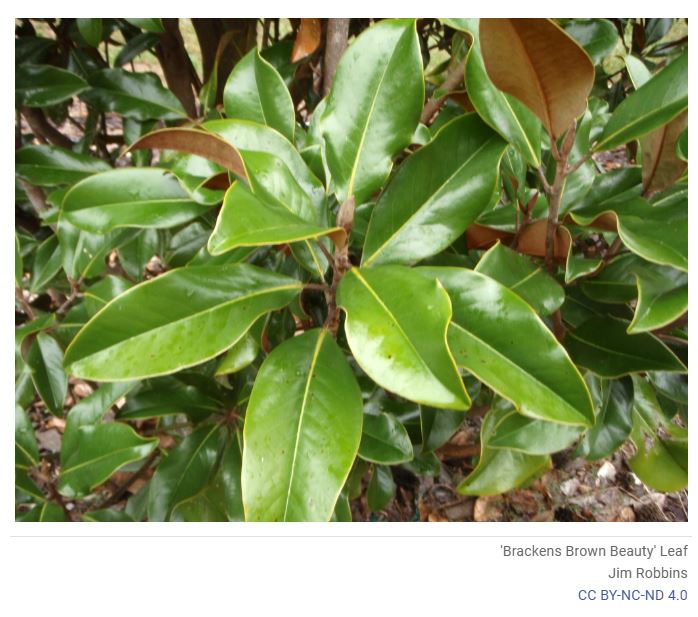
Bracken’s Brown Beauty is winter hardy to zone 6. Compact with smaller leaves.
Southern magnolia, is a large, broadleaf evergreen tree that is noted for its attractive glossy dark green leaves and its large, extremely fragrant flowers. It is native to the bottomlands and moist wooded areas in the central and southeastern coastal plains from North Carolina to Florida and Texas. It typically grows to 60 to 80 feet tall with a pyramidal to rounded crown, a spread of 20 to 40 feet wide, and a trunk diameter of 3 feet. It is a member of the magnolia family (Magnoliaceae). The species epithet is Latin for “large flowered.”
This is a magnificent tree for planting as a specimen in the South in large yards, parks, or commercial sites. Be sure to provide plenty of space to grow. Lower branches tend to reach the ground and can be pruned out to appear more tree-like. Nothing will grow underneath the tree, and it requires a mulch to prevent erosion problems.
Giant fragrant white flowers are borne in the summer months and are extremely ornamental. The woody brown fruits with bright red seeds are used in dried arrangments.
It prefers rich soil with partial shade and, in nature, is usually an understory tree. However, when grown as an ornamental, it maintains heavily leaved limbs almost to the ground. Tolerates high moisture levels, but is intolerant to overly wet or swampy soils and prolonged flooding.
Fire Risk: This plant has a medium flammability rating.
Insects, Diseases, or Other Plant Problems: Scale is an occasional pest problem. Leaf drop in both fall and spring. Leaves can be chopped with a rotary mower and blown back under the branches to recycle nutrients. A frequent escapee from cultivation. In many suburban yards, the mature size of this tree is way too large, consider a smaller cultivar.
Quick ID Hints: Leaves are rusty-brown and tomentose below

Nov 2024 City of Dickson Arboretum


 Dickson Tree Management & Beautification Board