
Quercus acutissima
Common Name(s): Japanese Silkworm Oak, Sawthorn Oak, Sawtooth Oak
Phonetic Spelling
KWER-kus ak-yoo-TISS-ee-muh
Description
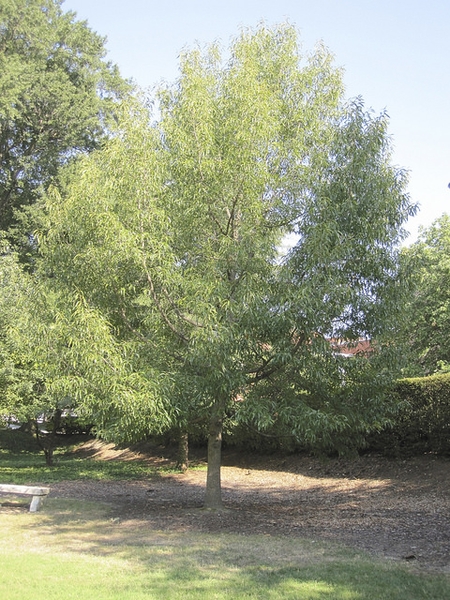
Sawtooth Oak is a medium-sized deciduous tree that grows from 40 to 60 feet tall and 30 to 50 feet wide and is native to Asia. It became popular as a street tree and in recent years has been invading forests in the eastern United States and is considered a noxious weed or invasive in some states. It has a pyramidal habit when young and becomes oval to broadly rounded with age. The leaves are alternate, lance-shaped, and have bristly teeth along the margins. The flowers are very small. inconspicuous, and usually bloom in May. The tree can produce acorns as young as 10 years of age and acorns are abundant on mature trees. The acorns are bitter and not a favorite of wildlife. Fall foliage is yellow to copper brown and often the leaves hang on through the winter months.
The genus name, Quercus, is the Latin name for oak trees. The specific epithet, acutissima, means acute or sharp and refers to the leaf margins of the Sawtooth Oak.
The Sawtooth Oak is native to Japan, Korea, China, and the Himalayas. It has been widely planted in the United States to serve as food for wildlife and as an ornamental tree. This tree is no longer recommended in the United States because of its invasive tendencies, particularly in the eastern United States. It is currently on the plant watch list for the Mid-Atlantic Natural Areas. It is known to seed into the landscape in Pennsylvania, Maryland, Virginia, North Carolina, Georgia, Alabama, Mississippi, and Louisiana. It is described as a noxious weed in some Midwestern States and is prohibited in Wisconsin. Consider planting native oaks instead.
The Sawtooth Oak is fast-growing and tolerant of a wide range of moisture and temperature conditions. It prefers acidic, humus, well-drained, moist soils in full sun but is adaptable to a variety of soil types. It is heat and humidity tolerant. Acorns and involucral cups provide a messy litter layer of fruits and twigs.
Quick ID Hints:
medium-sized deciduous tree, 40 to 60 feet tall, and 30 to 50 feet wide
gray to black bark with furrows and corky ridges
yellowish-green small male and female catkins emerge in the spring with the leaves
glossy, dark green, lance-shaped leaves with bristle-tipped marginal teeth at the end of each parallel vein
oval acorns measuring 1 inch long with a spiny and scaly cup (looks like twigs in a bird’s nest) that covers 2/3 of the acorn
Insects, Diseases, and Other Plant Problems: Potential insect pests include scale, oak skeletonizer, leaf miners, galls, oak lace bugs, borers, caterpillars, orangestriped oakworm, buck moth, whitemarked tussock moth, and nut weevils. Oak trees are susceptible to oak wilt, chestnut blight, shoestring root rot, anthracnose, oak leaf blister, cankers, leaf spots, and powdery mildew. Yellowing of the leaves, known as chlorosis, is common if planted in neutral or alkaline soils. Chlorosis will damage the tree severely.
Bruce Kirchoff

Liné1

Bruce Kirchoff

Harum Koh

Bruce Kirchoff

Janet Tarbox

 Dickson Tree Management & Beautification Board