Acer saccharum
Common Name(s): Hard Maple, Leucoderme, Northern Sugar Maple, Sugar Maple
Phonetic Spelling
AY-ser sa-KAR-um
Description
Northern sugar maple is a deciduous tree in the Sapindaceae (soapberry) family that is native to Eastern and central North America. Primarily found in the cooler, higher mountains of North Carolina, it prefers to grow in cove forests and other rich forests, especially over areas rich in magnesium and iron (mafic) and lime (calcareous). It is also commonly found in dry forests and woodlands, less typically extending to high elevation northern hardwood forests with acidic situations. It can be sporadically found throughout the Piedmont as it was introduced to the region as an ornamental plant. However, three subspecies of Acer saccharum do grow well in North Carolina: chalk maple (supsp. leucoderme) do well in the Piedmont, black maple (subsp. nigrum) do well in the mountains, and Florida maple (subsp. floridanum) do well in the Piedmont and Coastal regions.
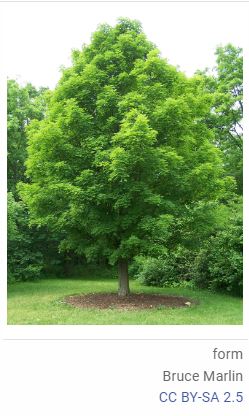
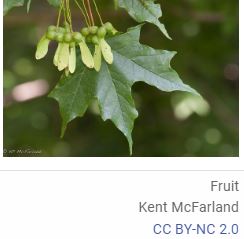
Northern sugar maple may reach 50 to 120 feet tall with a dense, spreading crown that provides heavy shade and grows at a slow to medium rate, although it may grow faster in open areas. The leaves have 5 lobes and coarsely toothed edges and turn brilliant shades of red, orange or yellow in the fall. In spring drooping racemes of yellow flowers are followed by winged samaras that are clustered on long reddish stalks in summer. It is the only tree commercially used today for syrup production. The sap is collected in the late winter and is concentrated by either boiling it or by reverse osmosis. 35-40 liters of sap make 1 liter of syrup. A single tree can produce 5-60 liters of sap per year. For best sap flow, this tree should be planted in areas where nights are below freezing and and days are higher than 5 degrees Celsius (~41 degrees Fahrenheit), which makes syrup production in North Carolina problematic.
Northern sugar maple grows best in moist, well-drained, slightly acidic, fertile soil in full sun but will tolerate average well-drained soils in sun to part shade. It is intolerant of compacted soil, high heat, air pollution, and road salt commonly found in urban environments. It is best used as a shade tree in lawns or park type settings. Select a specimen with southern provenance in warmer climates, zones 7 and above, so it will tolerate heat and humidity.
Insects, Diseases, or Other Plant Problems: No serious insect or disease problems. Aphids, borers, and scale may be present. Verticillium wilt, anthracnose, cankers, leaf spot, and tar spot can affect unhealthy trees. Leaf scorch may occur in drought conditions. Roots can crack sidewalks and clog drains and septic systems. Sensitive to heat, drought, salt, and soil compaction. See potential disease and insect problem fact sheets to the left. Downy serviceberry, is a deciduous tree in the Rosaceae (rose) family, native to eastern North America. It typically grows on wooded slopes and cliffs, open woods, wooded bluffs, rocky woodlands, limestone glades, riverbanks, and edges of swamps. It is not frost tender.



 Dickson Tree Management & Beautification Board